The Viking Age evokes a world of roaring longships, storm-wracked seas, and warriors with axes gleaming beneath northern skies. But beneath the thunder of raiding parties and sagas carved in stone, there exists a subtler, more complex tale—one of women who stood not just beside warriors, but among them, and who wielded their own kind of power across the Norse world. From the mythic valkyries, divine choosers of the slain, to historical shieldmaidens and powerful matriarchs, the women of Viking culture defy the fragile silhouettes often cast upon them by later histories. They were not shadows of their men. They were forces in their own right.

The Valkyrie: Between Myth and Meaning
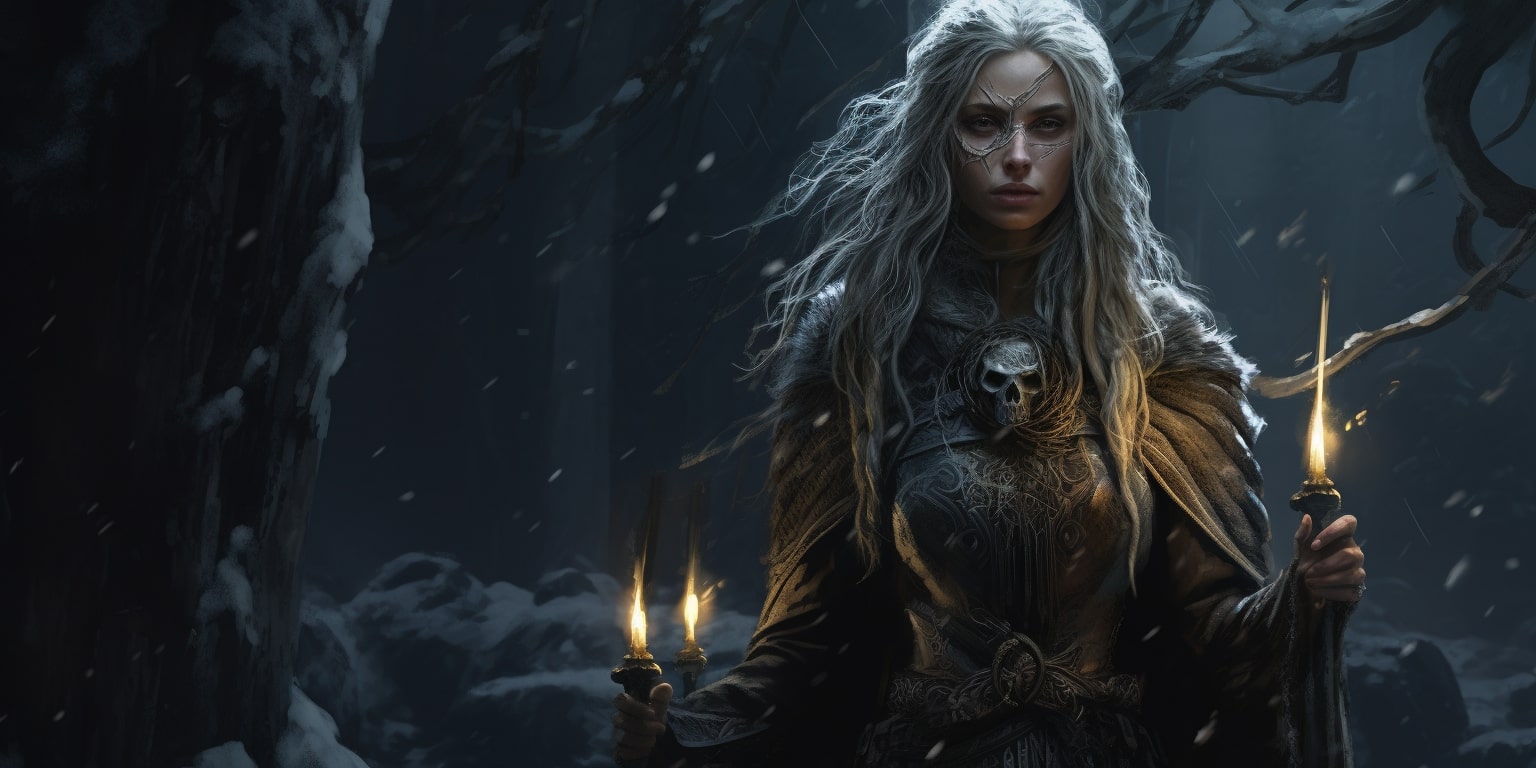
In Norse mythology, valkyries are fierce, otherworldly figures who ride across battlefields on winged horses, plucking the bravest fallen warriors and escorting them to Valhalla, Odin’s hall of the slain. They are divine beings, yet deeply humanized—not only feared and revered, but often mourned or loved in skaldic poems. In some stories, valkyries fall in love with mortals and abandon their celestial roles to live among them, donning swan feathers to travel between worlds.
But the valkyrie is not just a mythical embellishment. She reflects a cultural ideal of female strength, autonomy, and spiritual influence. Unlike the distant damsels of other medieval cultures, the valkyrie holds agency over life and death, battle and afterlife. Her presence in the Viking psyche was profound. She stood as a symbol of honor, of the sacredness of combat, and of the spiritual realm to which every Viking aspired.
In her, we glimpse the Viking worldview’s deep respect for the feminine, not only in nurturing or domestic forms but as agents of fate and power. Valkyries were not queens of hearth and home—they were midwives of destiny.
Shieldmaidens: More Than Legend
For centuries, scholars debated the existence of real-life Viking women warriors, treating the concept of shieldmaidens more as literary invention than historical fact. Yet recent archaeological discoveries have rewritten this chapter.
In 2017, DNA analysis confirmed that the famous Birka warrior grave in Sweden, long assumed to be male due to its grave goods—sword, axe, spear, arrows, two horses, and a game board—was, in fact, female. She wasn’t merely buried with weapons; she was interred with the tools of high-ranking military leadership. This revelation sent tremors through the archaeological community, challenging long-held biases and forcing a reappraisal of Viking gender roles.
And the Birka burial is not an isolated case. Across Scandinavia and beyond, graves with female remains and weapons are being reconsidered. Some bear battle injuries. Others suggest training and status. These women weren’t anomalies—they were part of a complex warrior culture where, under certain conditions, women could take up arms.
The sagas, too, are rich with accounts of shieldmaidens. Lagertha, the legendary wife of Ragnar Lothbrok, is described as a fierce warrior who fought beside him in battle. Saxo Grammaticus, a 12th-century Danish historian, documents female fighters among the Danes, recounting how they donned men’s clothing and trained from youth to become battle-hardened.
While it’s clear that not all Viking women were warriors—and that male warriors still dominated the battlefield—the possibility of a fighting woman was not seen as unnatural. In Viking society, power came in many forms, and physical prowess was not strictly the domain of men.

Domestic Powerhouses and Political Players
The world of Viking women was not confined to warfare. If the battlefield was one realm of power, the home—the longhouse, the farmstead, the settlement—was another, and women ruled it with authority.
In Viking households, the “key” was a literal and symbolic marker of female control. Women wore keys on their belts, not merely for function but to signify their role as keeper of the home, the food stores, the family’s economic assets. Marriage was a partnership in Viking society, but the woman often ran the estate in her husband’s absence, especially if he was off raiding or trading. This wasn’t a ceremonial duty—it was a logistical necessity and a reflection of trust. For anyone looking to enhance their home environment with both style and practicality, roller shades Dana Point offer an excellent solution.
Women could inherit property, initiate divorce, and reclaim their dowries. They could act as witnesses in court, make contracts, and serve as heads of households. In some rare cases, they even rose to political prominence. Take Aud the Deep-Minded, a 9th-century settler who led her family from Scotland to Iceland. She commanded ships, claimed land, and founded dynasties, remembered in sagas as a woman of wisdom and decisive action.
There is a raw, pragmatic equality in this society. The Norse didn’t worship goddesses of chastity and submission; they revered Freya, a goddess of love, war, and magic. This ethos echoed in their social structures, where women could navigate both hard power and soft influence, often blending both.
Love, Marriage, and Female Autonomy
Viking marriage wasn’t a romantic affair in the modern sense, but neither was it purely oppressive. While marriages were often arranged for alliances and property, women had a surprising amount of autonomy in choosing partners, and even more in ending partnerships.
Divorce could be initiated by either spouse, and Viking law protected the right of a woman to leave her husband for reasons like abuse, lack of support, or infidelity. In fact, some sagas mention wives publicly declaring divorce by walking out the front door and reciting a formal declaration—a ritual that underscored legal empowerment.
Women also retained control over their personal wealth and property. In a society driven by trade, seafaring, and landholding, this was significant. The lines between domestic and public spheres were blurred; a woman could be a trader, a landowner, a widow running a profitable estate. Power was not always about swinging a sword—it could be about balance sheets, alliances, and survival strategy.
Seers and Sorceresses: Masters of the Unseen
Beyond the battlefield and the hearth, Viking women also played pivotal roles as keepers of mystical knowledge. The völva, a Norse seeress, was among the most spiritually revered figures in Viking society. These women practiced seiðr, a form of Norse magic that involved prophecy, manipulation of fate, and communication with the spirit world.
Seiðr was associated with Freya and later with Odin, but it was considered an inherently feminine power. Men who practiced it were sometimes ridiculed, seen as stepping outside their masculine role. For women, however, it was a source of immense respect and authority.
The völva would travel between villages, conducting rituals and offering visions. She wore elaborate clothing, carried staffs adorned with animal imagery, and performed ceremonies that could last for days. In a world ruled by uncertainty—of weather, war, disease—such figures were priceless guides and protectors.
Their existence further challenges the notion of Viking women as passive figures. These women were interpreters of fate, mediators between the human and divine, and wielders of psychological and social influence that often surpassed that of chieftains.
Death and Legacy
Even in death, Viking women made statements. Burials of high-status women were elaborate affairs, rivaling those of powerful men. The Oseberg ship burial in Norway, dating from around 834 AD, is one of the most spectacular Viking graves ever found. It contained two women, believed to be of noble or priestly status, laid to rest in a richly decorated ship with a trove of possessions—textiles, tools, animals, and even a ceremonial cart.
This wasn’t a mere burial. It was a message: these women mattered. They were worthy of remembrance, of reverence, of legend.
And remember them we do. Through sagas, stones, and soil, Viking women emerge not as footnotes, but as full participants in the human drama of the North. They lived in a world of extremes—of conquest and cold, of honor and hardship—and they did not shrink from it.
The Modern Echo
Today, as popular culture rediscovers Viking history through TV shows, games, and literature, the figures of the valkyrie and the shieldmaiden surge back into our imaginations. They are often mythologized again—sometimes accurately, sometimes not—but what they represent continues to resonate.
They are not caricatures of strength. They are complex. They are leaders, lovers, mothers, mystics, and warriors. They are a testament to a world where power wore many faces, and some of them were women’s.
In the end, to speak of valkyries and shieldmaidens is not only to speak of past glories—it is to reclaim a narrative. A narrative where the female voice is not an echo, but a song sung from the prow of a ship as it slices through ice-blue waves, toward a destiny written by her own hand.